
Food
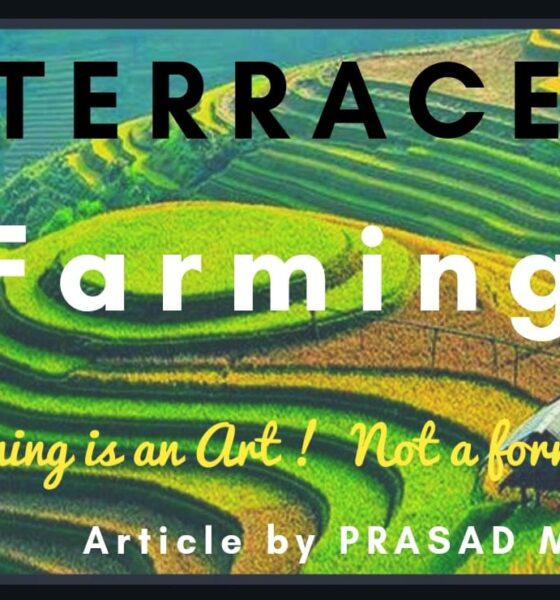
Terrace Farming- A clever way to grow greens.
People around the world have discovered clever ways to farm in tough conditions. Their land could be too dry, too wet, too hot, or prone to insects or damaging storms. If the land is too steep, people might try terrace farming. Cultures in Peru, Japan, the Philippines, Mexico, the Mediterranean, East Africa, Yemen, and China have all independently created the concept of terracing. In many parts of India also terrace farming is practised.

How terrace farming is done?
Terrace farming is the practice of cutting flat areas out of a hilly or mountainous landscape in order to grow crops. It is a practice that has been in use from the rice fields of Asia to the steep slopes of the Andes in South America.
Terracing turns a slope into level, benched out steps by moving soil and creating retaining walls. This restructuring allows un-farmable hillsides to become stable, productive farmlands. Some typical crops grown in terraces include barley, wheat, potatoes, corn, tea, olive, grape vines, coffee, and rice. A terrace is typically about 2-3 meters wide and 50-80 meters long. Some terraces flood with rain water, such as those used to farm rice.
A terrace usually has one outlet for water to drain into the terrace below. This lower terrace stops the water and prevents it from gaining enough speed to cause erosion. This way, the water deposits any soil in the downhill terraces as it slows down.
Terrace farming in INDIA
In India, terrace cultivation takes place in the states of Punjab, Meghalaya, Haryana, Plains of Uttar Pradesh, Himachal Pradesh and Uttaranchal. Although terrace farming is not much effective way of farming but its great idea to increase area under cultivation.

Some crops that are grown using terrace farming are – paddy, cereals, fruits, vegetables, flowers, medicinal plants, aromatic plants, dye plants, wheat, maize, rice, pulses, oilseeds, millets, buckwheat, saffron, black cumin, grain amaranth, spices, etc. The major fruit crops are apple, subtropical and temperate fruits including nuts and dry fruits.
Terraces are classified under different categories :
- According to retaining walls: bench terraces and broad field bench terraces, check dams and cross-channel terraces, sloping field terraces.
- Relating to the differences in building materials: soil ridge terraces, stone dike terraces, grass ridge terraces, and soil–rock mixed terraces
- According to rainfall availability and climatic zones: dryland terraces and paddy terraces
- Based on purpose: agricultural terraces, afforestation terraces, orchard terraces, tea-garden terraces, rubber terraces, and mulberry terraces
- As per specific location: hill slope terraces and channel terraces.
BENEFITS OF TERRACE FARMING :
1. Terrace farming boosts water Conservation and runoff reduction: terraces are act as many micro-watersheds across the whole slopes. Therefore, it directly reshapes the micro-topography of hill slopes. These factors enhance the efficiency of rainwater harvesting by changing hydrological pathways. Even, Practice of terrace farming increases soil roughness and creates voids so that water droplets penetrate. Thus, it increases water holding capacity and soil moisture.
2.Soil conservation and Control of Soil Erosion: Terracing weakens rainfall-runoff effects by reducing the water velocity and total amount of debris flow. This leads to an increase in biomass and surface cover. Terraces have embankments or ridges which increases the efficiency of soil conservation
3. Improve land productivity and soil fertility:
Due to the reduction in soil erosion and having high water holding capacity, terrace farming improves soil fertility and land productivity
Example:
In rice terraces, Irrigation is designed not only for supplying water to paddy crops but has various other purposes as well also in addition to the protection of terraced paddy fields, the unique practice of year-round irrigation plays many essential roles, including storing water, maintaining favorable soil conditions for rice growth and providing a habitat for various edible aquatic animals.
4. Ensure food security and crop yield: water scarcity and soil erosion are the problems for the mountain. Terrace farming ensures food security and increases crop yield by water and soil conservation. Thus it reduces soil erosion. In terrace farming, the interaction between water and fertilizer increase results in high yield.
5. Enhances biodiversity and helps in ecosystem restoration and enhances biodiversity: Practice of Terrace farming in mountains or another region where standard cultivation not possible plays an additional measure.This benefits ecosystem restoration and enhancing biodiversity.
6. Enriches recreational options by creating aesthetic landscapes: Many terraces practices in the world classified as “cultural landscape” heritages (UNESCO, 2008). Cultural landscapes, defined as “distinctive geographical areas or unique properties that represent the combined work of nature and man” by the World Heritage Committee.
Challenges in terrace farming:
Terrace farming certainly has difficulties, as well. Terracing requires massive inputs of labor. Creating a terrace requires moving tons of soil and building hundreds of meters of stone walls, typically by hand. Once established, terraces need routine maintenance to continue functioning. Historically, labor was readily available in rural, mountainous areas of the world. Currently, however, young, able-bodied people move to cities to become educated and work higher paying jobs. Older women and men maintain the terraces, instead. This lack of labor results in less upkeep. Once a terrace is abandoned, the retaining walls crumble and nearly all of the productive topsoil is lost to wind and water erosion.
From a natural point of view, steep slopes are some of the only areas spared from human manipulation. In places where all flat areas and small hills have been deforested, steep slopes are important for the remaining wildlife and plants. If terrace farming increases, these remnant ecosystems will inevitably be lost.

-

 Entertainment6 years ago
Disha Patani is a National crush and Why?
-

 Paradox recommends6 years ago
WAJID KHAN song list forever in heart and on the playlist
-

 Interview6 years ago
Madhura Joshi Divekar tells us her story, passion and more.
-

 Entertainment5 years ago
Best bollywood villains of 90s and the iconic actors.
-

 Interview5 years ago
Tirth Parsana: one who gives a laughter pill
-

 Business6 years ago
Elon Musk : undaunted visionary character shaping our future
-

 Paradox recommends6 years ago
Top webseries you must watch.
-

 Fashion6 years ago
SABYASACHI LEHENGA : A dream of every girl.
-

 influencer stories5 years ago
Neha Kulkarni who does Nasti Uthathev!
-

 Fashion6 years ago
WHEN IN DOUBT, WEAR A DENIM