Sports
All about perseverance rover, NASA’s mission to mars.
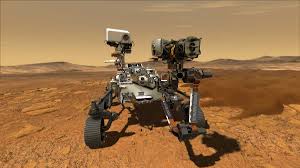
Perseverance rover is one in all the foremost explorer which landed on mars as part of NASA’s ongoing 2020 mars missions. The rover was launched in July and executed its landing on 18th February. The rover has travelled a distance of 293 million miles to achieve mars since its landing on a United Launch Alliance Atlas V rocket on July 20. Perseverance isn’t just another rover mission. Perseverance is taken into account to be the foremost advanced and costliest rover sent to mars. NASA had invested around $2.4 Billion to make and launch the mission. Another $300 million is anticipated to be spent so as to keep up the operational qualities within the rover.
The rover could be a size of a tiny low car, weighing around one ton and is ten feet long by 9 feet tall. It even contain some external equipment. First, it’s harboured a singular instrument called the MOXIE or Mars Oxygen ISRU Experiment. MOXIE was an instrument designed to provide oxygen on Mars by transmogrifying the carbonic acid gas molecules present within the Martian atmosphere.
The second major equipment harboured by the rover which can be the cornerstone of human existence on mars in upcoming years; ISRU. ISRU means in place Resource Utilization: or the employment of local resources to fulfil human needs or requirements of the spacecraft. Without ISRU, exploration of Mars within the future decades are going to be incredibly expensive and thereby impossible. ISRU’s ain objective is to initialize the basin human demands for the long run astronauts who will visit mars. If astronauts need to carry oxygen or water or rocket propellent for his or her journey for a two-year journey to Mars and back, the price are going to be understandably excessive. In a way, this is often almost like a traveller from New Delhi having to hold their own oxygen, food supplies and aircraft fuel for a two-year stay in New York: the price per passenger are going to be incredibly high.
If oxygen are often successfully extracted on Mars in some significant scale, this will have two direct advantages: first, the oxygen are often used for human visitors to Mars, and second, the oxygen will be wont to manufacture propellant for the return journey. Thus, if the technology demonstration is successful, NASA can easily proportion the oxygen generation rate per day for MOXIE by 100 times: this could be of great use for a future human mission to Mars.
Third, Perseverance will carry Ingenuity, the primary ever helicopter to fly Mars. this can be the primary time NASA will fly a helicopter on another planet or satellite. Ingenuity may be a technology demonstration: the challenge, of course, is to fly the helicopter within the thin atmosphere of Mars. sort of a drone Earth, a Mars helicopter can help in rover drive planning and in fetching samples from locations that the rover cannot safely drive to. If this technology demonstration is successful, we’ll see a greater role for such helicopters in future missions.
Fourth, Perseverance is that the planned commencement to bring back rock samples from Mars for analysis in sophisticated laboratories on Earth: with the goal of searching for biosignatures: or signatures of present or past life. Perseverance will collect samples and a second rover mission will fly within a decade to assist transport the rock samples back to Earth.
The analysis of Martian rocks on Earth will likely provide a reliable indication of whether life on Mars is possible within the past or at this time.
What will the perseverance do ?
Perseverance is that the opening move in an exceedingly multi-step project to bring samples back from Mars. The study of the returned rock samples in sophisticated laboratories everywhere the planet will hopefully provide a decisive answer on whether life existed on Mars within the past.
Here are the steps within the Sample Return:
As the start, Perseverance will collect rock and soil samples in 43 cigar-sized tubes. The samples are collected, the canisters are sealed, and left on the bottom.
The second step is for a Mars Fetch Rover (provided by the eu Space Agency) to land, drive, and collect all samples from the various locations, and return to the lander.
The Fetch Rover will then transfer the canisters to the Ascent Vehicle. The Mars Ascent Vehicle will meet with an Orbiter after which the Orbiter will carry the samples back to Earth.
This long-term project is termed MSR or Mars Sample Return. MSR will revolutionise our understanding of the evolutionary history of Mars. If MSR is successfully executed, we are going to have an inexpensive answer of whether there was microscopic life on Mars.
But MSR does have its risks. If one in every of the components fails, just like the Fetch Rover or the Mars Ascent Vehicle, MSR is doomed. A hidden risk is strategic. At the price of MSR, there can be 5-10 spacecraft missions to different parts of the solar system: so hence, by choosing MSR, NASA forecloses the choice to undertake those other missions.

-

 Entertainment6 years ago
Disha Patani is a National crush and Why?
-

 Paradox recommends6 years ago
WAJID KHAN song list forever in heart and on the playlist
-

 Interview6 years ago
Madhura Joshi Divekar tells us her story, passion and more.
-

 Entertainment5 years ago
Best bollywood villains of 90s and the iconic actors.
-

 Food6 years ago
Terrace Farming- A clever way to grow greens.
-

 Interview5 years ago
Tirth Parsana: one who gives a laughter pill
-

 Business6 years ago
Elon Musk : undaunted visionary character shaping our future
-

 Paradox recommends6 years ago
Top webseries you must watch.
-

 Fashion6 years ago
SABYASACHI LEHENGA : A dream of every girl.
-

 influencer stories5 years ago
Neha Kulkarni who does Nasti Uthathev!