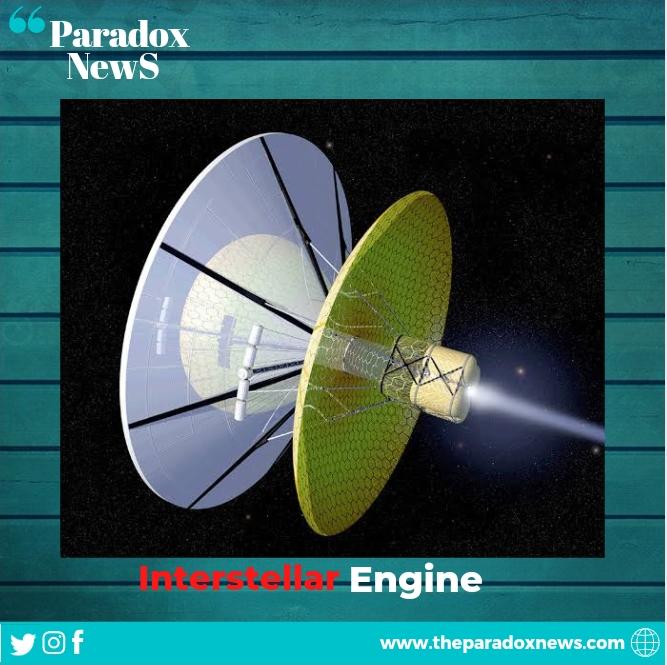

INTERSTELLAR ENGINE : Let’s make a moving sollar system ImageNothing in the Universe is static. In the milky way, billions of stars orbit the galactic center.Some, like our sun, are pretty consistent, keeping a distance of around 30,000 light years from the galactic center, completing an orbit every 230 million years.
This dance is not an orderly ballet – more like a skating rink filled with drunk toddlers. This chaos makes the galaxy dangerous. Our solar neighbourhood is constantly changing, with stars moving hundreds of kilometers every second.
Only the vast distances between objects protect us from the dangers out there. But we might get unlucky in the future. At some point we could encounter a star going supernova. Or a massive object passing by and showering earth with asteroids.If something like this were to happen we would likely know thousands, if not millions of years in advance. But we still couldn’t do much about it.Unless… we move our whole solar system our way Image A INTERSTELLAR ENGINE Stellar engines are a class of hypothetical megastructures which use a star’s radiation to create usable energy. The concept has been introduced by Badescu and Cathcart. Some variants use this energy to produce thrust, and thus accelerate a star, and anything orbiting it, in a given direction .The creation of such a system would make its builders a Type-II civilization on the Kardashev scale.
A Stellar engine have a capacity to move a whole solar system. But a question arise “Here how can we move a whole solar system with the help of a single stellar engine ? ” .The answer is as simple as question i.e by simply moving out the sun. As we move the sun all the planet and asteroid under his will move along sun on his path .
There are lots of idea about a stellar engine and its working.
We can make 2 type of stellar engine on are current understanding of physics.
1) Shkadov Thruster
2) Caplan Thruster
Shkadov Thruster Image
One of the simplest examples of a stellar engine is the Shkadov thruster (named after Dr. Leonid Shkadov who first proposed it), or a Class A stellar engine.[4] Such an engine is a stellar propulsion system, consisting of an enormous mirror/light sail—actually a massive type of solar statite large enough to classify as a megastructure—which would balance gravitational attraction towards and radiation pressure away from the star. Since the radiation pressure of the star would now be asymmetrical, i.e. more radiation is being emitted in one direction as compared to another, the ‘excess’ radiation pressure acts as net thrust, accelerating the star in the direction of the hovering statite. Such thrust and acceleration would be very slight, but such a system could be stable for millennia. Any planetary system attached to the star would be ‘dragged’ along by its parent star. For a star such as the Sun, with luminosity 3.85 × 1026 W and mass 1.99 × 1030 kg, the total thrust produced by reflecting half of the solar output would be 1.28 × 10¹⁸ N. After a period of one million years this would yield an imparted speed of 20 m/s, with a displacement from the original position of 0.03 light-years. After one billion years, the speed would be 20 km/s and the displacement 34,000 light-years, a little over a third of the estimated width of the Milky Way galaxy.
Caplan Thruster

Astronomer Matthew E. Caplan of Illinois State University has proposed a type of stellar engine that uses concentrated stellar energy to excite certain regions of the outer surface of the star and create beams of solar wind for collection by a multi-Bussard ramjet assembly, producing directed plasma to stabilize its orbit, and jets of oxygen-14 to push the star. Using rudimentary calculations that assume maximum efficiency, Caplan estimates the Bussard engine would use 1015 grams per second of solar material to produce a maximum acceleration of 10−9 m/s2, yielding a velocity of 200 km/s after 5 million years, and a distance of 10 parsecs over 1 million years. While theoretically the Bussard engine would work for 100 million years given the mass loss rate of the Sun, Caplan deems 10 million years to be sufficient for a stellar collision avoidance. His proposal was commissioned by the German educational YouTube channel Kurzgesagt.

-

 Entertainment6 years ago
Disha Patani is a National crush and Why?
-

 Paradox recommends6 years ago
WAJID KHAN song list forever in heart and on the playlist
-

 Interview6 years ago
Madhura Joshi Divekar tells us her story, passion and more.
-

 Entertainment5 years ago
Best bollywood villains of 90s and the iconic actors.
-

 Food6 years ago
Terrace Farming- A clever way to grow greens.
-

 Interview5 years ago
Tirth Parsana: one who gives a laughter pill
-

 Business6 years ago
Elon Musk : undaunted visionary character shaping our future
-

 Paradox recommends6 years ago
Top webseries you must watch.
-

 Fashion6 years ago
SABYASACHI LEHENGA : A dream of every girl.
-

 influencer stories5 years ago
Neha Kulkarni who does Nasti Uthathev!