
Interview
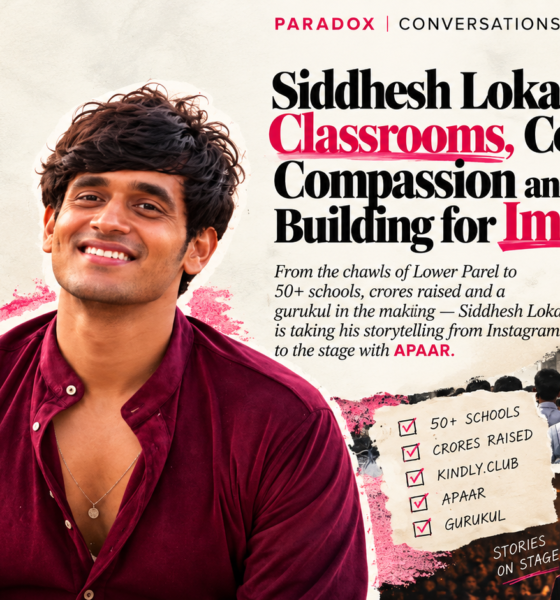
Siddhesh Lokare on Sidiously, Social Impact & APAAR
What happens when a creator starts asking what should happen after the camera stops recording?
For Siddhesh Lokare, that question has gradually transformed the way he creates.
Known online as Sidiously, Siddhesh has built his journey around storytelling, entertainment and an increasingly visible focus on social impact. But his story did not begin with a plan to become a social-impact entrepreneur.
It began in the chawls of Lower Parel, with a family that worked hard without much recognition, followed by a full-time job, a growing interest in making videos and, eventually, a decision to turn content creation into a career.
What changed along the way was not his desire to create. It was what he wanted his creation to create for.
In this conversation, Siddhesh talks about his journey from chasing views to building initiatives around education, his experiences in Dharavi and Palghar, the responsibility that comes with fundraising, the challenges of storytelling around vulnerable communities, and why he believes rebuilding a school is only the beginning.

1. Who is Siddhesh Lokare beyond Sidiously?
What was your journey before becoming a creator and social-impact entrepreneur?
I grew up in the chawls of Lower Parel. My father sold vegetables on the road, and my mother would cook for 20 people and still find a way to study. I saw how hard they worked, often without anybody noticing. So, honestly, when I was young, I wanted to be noticed.
Before Sidiously, I had a full-time job. When I started making videos, I wasn’t thinking about building an organisation or changing education. I was trying things, making people laugh, and figuring out whether I could make something of my own.
That hunger to create is still there. What changed is what I want to create for.
2. How did Sidiously begin?
What was the first moment when you realised content creation could become your career?
Sidiously began in October 2022, alongside my job. I made all kinds of videos and challenges. I cared about views, brand deals, and whether people remembered my name. I don’t want to rewrite that part of my journey to make it sound more noble.
I enjoyed creating, and I wanted it to work.
The turning point came when I saw that people would do more than watch. They would respond, show up, and trust me with something that mattered to them.
That made me realise content could become my work.
I quit my job in July 2023, but I was still learning what kind of creator I wanted to be.
3. From views to impact: What caused the shift?
You initially created content for views and virality, but later moved towards social impact. What changed?
Views are exciting. Then you get them, and the next morning you want more.
For me, the deeper change happened through the people I met while filming.
I met Kasturi at a school in Palghar. Her mother had cancer, and when I asked Kasturi what she wanted to do once she started earning, she said she wanted to take care of her mother.
I remember standing there with my camera, thinking about how clear she was about what mattered to her.
I couldn’t just go home and think about that as a good video. I wanted to know what could change for her after people watched it.
4. The Dharavi experience that changed the question
You have spoken about your experience in Dharavi and how it changed your perspective. What exactly happened?
About six months after I started creating content, I went to Dharavi to celebrate my birthday as part of a project.
I was spending time with children there, and seeing their joy stayed with me.
I had grown up knowing what it meant to have limited resources, but that day made me think differently about what I could do with the audience I was building.
It wasn’t one dramatic moment where I suddenly had my whole life figured out.
I went home with a question:
If people are willing to pay attention to what I make, could that attention actually help someone?
That question kept growing.
5. From ₹18,400 to raising crores for education
You reportedly started your fundraising journey with just ₹18,400 from 40 strangers. How did that experience evolve?
The first time I asked people to contribute to a school, I was terrified.
It was a school in Dharavi with about 80 children and a roof that needed fixing. I had around 2,000 Instagram followers. There was no donation page or proper system.
I asked people to message me, and 40 strangers sent ₹18,400 through GPay.
When the money arrived, my first thought was:
“Now I’m responsible for this.”
We fixed the roof with the school, documented the work, shared the receipts, and thanked every donor personally.
As the projects became bigger, that responsibility became bigger too.
Mission 30303 eventually raised ₹3 crore for government schools, but the principle came from those first 40 people:
Show people what you’re asking for. Do the work. And show them what happened afterwards.
6. Rebuilding a school is only the beginning
You’ve worked on rebuilding government schools. What do you think is the biggest problem with India’s government-school education system today?
The biggest problem, from what I’ve seen, is the gap between a child getting into school and that child getting a real chance to grow there.
At some schools, the immediate need is a safe classroom, a toilet, water, or a place to sit. Those things matter enormously.
But once we’ve built them, we have to keep asking more questions.
Is the child learning with confidence?
Do they get to try art, sport, coding, or something they didn’t know existed?
Does a teacher have the support to make those opportunities real?
I’ve been part of projects that fixed buildings. I’m proud of the difference those changes make.
I also know the work can’t end when the new classroom opens.
7. Why Kindly.club?
What exactly is Kindly.club, and why did you feel India needed another platform connecting donors, CSR and grassroots causes?
Kindly.club grew out of a question people had every right to ask me:
“I donated. What happened next?”
I had put my face behind causes, and sometimes I couldn’t give a clear enough answer about where a donation had gone.
That bothered me.
Kindly is our attempt to connect people who want to help with real needs on the ground, and to make the journey of a donation visible through updates and outcomes.
We don’t need another place that only makes it easy to click “donate.”
We need to earn someone’s trust after they’ve donated, too.
Whether a person gives ₹100 or a CSR team supports an entire school, they deserve to see what changed.
8. When virality meets responsibility
As someone with millions of followers, how do you balance virality with authenticity when telling stories about vulnerable communities?
I understand why a story needs to hold someone’s attention.
If nobody watches, the person or cause may never get the support it needs. But every choice I make while filming can affect how the audience sees a real human being.
So I try to begin with listening.
What does this person want to say?
What are we asking the audience to understand or do?
And once the video is out, what happens next?
A viral video can open a door. The work is in walking through that door responsibly, with the people whose story made it possible.
9. Can social-impact stories become content without becoming exploitation?
Social-impact creators are sometimes criticised for “performative activism” or “poverty porn.” How do you make sure the people you’re trying to help don’t simply become content?
I think creators should take that criticism seriously. Having good intentions doesn’t mean every filming decision is good.
I have to ask myself whether I would still show up if the camera weren’t there.
I have to think about consent, dignity, and whether I’m sharing more of someone’s pain than the audience needs to see.
And I have to be willing to return after the post is published, speak to the person again, and account for what happened.
I’m still learning this.
But I never want somebody to feel that their hardest day became the most useful day for my page.
10. What’s next for Siddhesh Lokare?
Do you see yourself primarily as a creator, entrepreneur, social entrepreneur, or someone building something much bigger?
I’ll always be a creator.
Storytelling is how I found my way into this work, and I still love it. But I want the stories to help build things that last beyond a video.
That’s what I’m trying to do through Kindly.club, Create Together Foundation, our work with schools, and now Yugantar, the residential Gurukul we want to build for girls in Maharashtra.
APAAR is one way we’re inviting people into that dream through a live show.
If you ask me what I want to be known for years from now, I hope it’s more than a number of followers.
I hope people can point to children, schools, and opportunities that are there because a lot of people came together and decided to build them.
From Creator to Change-Maker
Siddhesh Lokare’s journey reflects a broader question facing creators today: what happens when an audience becomes more than a number?
For Siddhesh, the answer has increasingly been found in education, community-led initiatives and building systems that can continue beyond a single Instagram post.
His journey from creating videos alongside a full-time job to working across social impact, education and entrepreneurship has also changed the role he sees storytelling playing.
The camera is still there.
The desire to create is still there.
But the ambition has expanded from being seen to helping other people be seen, heard and given an opportunity to grow.
And with APAAR, that storytelling is now moving from the Instagram feed to the stage — bringing real-life stories into a live format through theatre, music, dance and visual storytelling, while connecting the experience to a larger vision around education and opportunity.
Because perhaps the real question is not how many people watched the story.
It is what happened after they did.

-

 Entertainment6 years ago
Disha Patani is a National crush and Why?
-

 Paradox recommends6 years ago
WAJID KHAN song list forever in heart and on the playlist
-

 Interview6 years ago
Madhura Joshi Divekar tells us her story, passion and more.
-

 Entertainment5 years ago
Best bollywood villains of 90s and the iconic actors.
-

 Food6 years ago
Terrace Farming- A clever way to grow greens.
-

 Interview5 years ago
Tirth Parsana: one who gives a laughter pill
-
 Business6 years ago
Elon Musk : undaunted visionary character shaping our future
-

 Paradox recommends6 years ago
Top webseries you must watch.
-

 Fashion6 years ago
SABYASACHI LEHENGA : A dream of every girl.
-
 influencer stories5 years ago
Neha Kulkarni who does Nasti Uthathev!