education
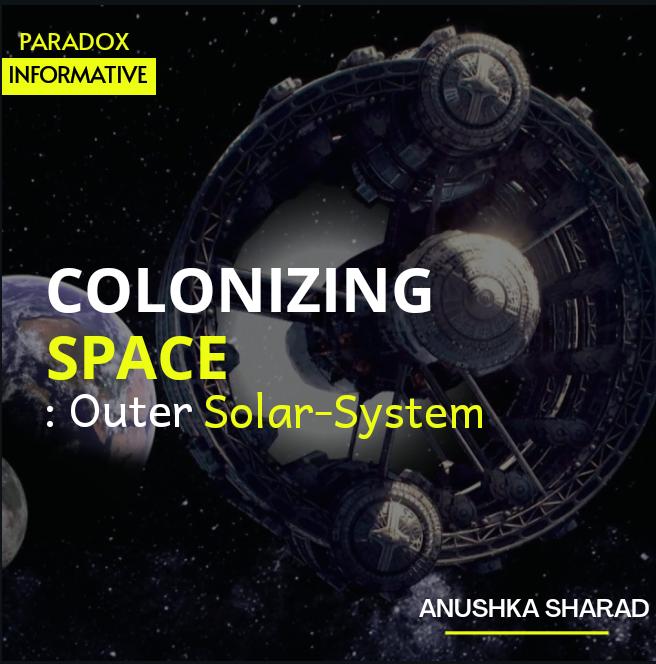
Colonizing Space: Outer Solar System
If you have read our 1st part of this article ‘Colonizing Space: Inner Solar system’https://theparadoxnews.com/uncategorized/colonizing-space-inner-solar-system/
Than you’ve landed on absolutely correct place to read more about habitation in Outer Space. You might wonder what’s the difference between Inner and Outer Solar system? Mercury, Venus, Earth, and Mars are the planets closest to the Sun. They are called the inner planets The outer planets are Jupiter, Saturn, Uranus, and Neptune. Today our focus is mostly on moons.

When we talk about a planet we are talking about a large but nonetheless finite environment. When we talk instead about living in space we have moved into the realm of the infinite. The resources of the Solar system are beyond human comprehension and the resources of the universe are as close to infinite. Using these materials to construct space colonies, we can provide all of the land area that any foreseeable population growth could require. With industry moved into space, our civilization could evolve. Imagine a society enjoying all the benefits of hightech living without the disadvantages of pollution and destruction of the natural environment.
 When we speak of bringing in extraterrestrial materials or energies we are discussing the creation of new wealth, not merely the redistribution of wealth already on Earth. Scientists have observed that energy derived from space would not be geographically bounded. There would no longer be energy rich or energy poor areas. The same can be said of availed space resources.
If these ideas are correct, then by the 23rd century there could conceivably be more people living in space than on Earth.
The surface of our world would be free of the polluting industries. Earth could be rejuvenated and restored to a more natural form. The assumption that other intelligences in the universe might use similar techniques to colonize space vastly increases the odds that we will find them. On the more practical side, man’s options are also vastly increased. If we use the technology that we have wisely, we can utilize all of the energy and natural resources that we could ever need. Once man is out into space there will be no more limits to growth. With the seed of man spread throughout the galaxy the human species would, in effect, become immortal.
Coming back to the point about habitation in Outer Solar system.
The asteroid belt is always the first priority for colonization. asteroids are extremely reach in minerals. They’ve got plenty for rock and metal for construction purposes and also have availability of water. Asteroids receive descent amount of sunlight that could be used as a power source to row plants. Asteroids contain several chemical composition classes, including iron and carbonaceous, providing a variety of materials usable in building and fueling spacecraft and space habitats.
Human colonization of the planet Jupiter is beyond the abilities of any type of imagined technology. Due to its lack of surface, any type of colony on Jupiter would have to be airborne but we have an option.
Europa the moon of Jupiter is probably the best place to build a permanent place in the Jovian system. The icy surface of the moon, although freezing, is solid enough to establish buildings, habitats, and structures. It looks to be relatively smooth but still retains signs of activity brewing as a result of the subsurface ocean sitting right beneath all that ice. That ocean, though dotted by geysers, might possess the ingredients for extraterrestrial life to evolve.
Enceladus is Saturn’s sixth-largest moon and essentially an alternate version of Europa in a lot of ways. It’s an icy surface with another subsurface ocean and if humans could find a way to weather the cold, they could probably build some sturdy homes on the surface. Again, there are geysers which point to internal activity deep in the rock, which could help facilitate the evolution of life. The challenges we have with these moons are; extremely cold weather, low gravity and low escape velocity.
Saturn’s Moon Titan perhaps is the most advantageous locale in the outer Solar System for colonization. It is the only natural satellite in the solar system with a dense atmosphere and cloud cover. Titan is the most hospitable extraterrestrial world within our solar system for human colonization. The surface of Titan is mostly non-cratered and thus inferred to be very young and active, and probably composed of mostly water ice, and lakes of liquid hydrocarbons (methane/ethane) in its polar regions. While the temperature is cryogenic, it should be able to support a base, but more information regarding Titan’s surface and the activities on it is necessary.
The thick atmosphere and the weather, such as potential flash floods, are also factors to consider.Titan retains a gravity that’s actually comparable to Earth’s moon, so we’d simply have to apply lessons from the latter to the former if we ever wanted to colonize it. It’s a fairly flat surface and should be easy enough to build upon.
Uranus and Neptune are more like an Ice giants than Gas giants. To colonize both of these we’d need more robotic activity otherwise floating cities in atmosphere. To the last point of colonization we could look forward for moons of Uranus and Neptune, Kuiper’s belt some comets, etc. Rather than planets, as the major potential habitat of life in space. Artificial gravity colonies are theoretically possible, but long travel times would make external resources quite difficult to obtain.

-

 Fashion6 years ago
4 more clicks please!
-

 Entertainment6 years ago
Disha Patani is a National crush and Why?
-

 Paradox recommends6 years ago
WAJID KHAN song list forever in heart and on the playlist
-

 Fashion6 years ago
When sonam kapoor gave us major princess goals.
-

 Interview5 years ago
Madhura Joshi Divekar tells us her story, passion and more.
-

 Entertainment5 years ago
Best bollywood villains of 90s and the iconic actors.
-

 Food6 years ago
Terrace Farming- A clever way to grow greens.
-

 Entertainment6 years ago
OUR CELEBRITY BRIDES!
-

 Interview5 years ago
Tirth Parsana: one who gives a laughter pill
-
 Business6 years ago
Elon Musk : undaunted visionary character shaping our future
2 Comments