
education
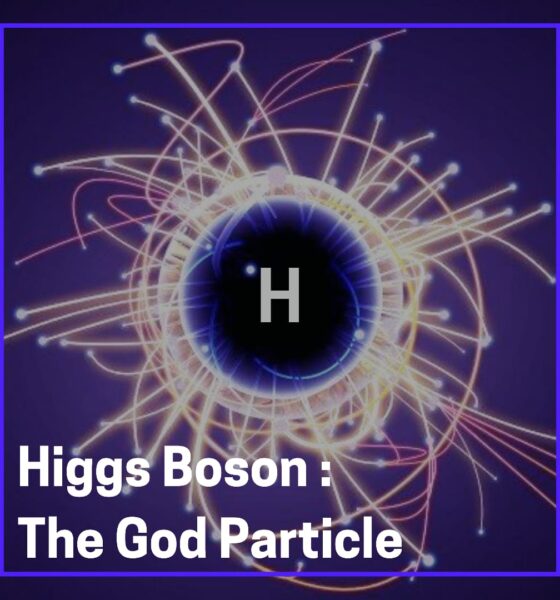
Higgs Boson : The God Particle
In 2012 at CERN laboratory, scientist found a new particle with mass of 125 GeV which was later confirmed to be the ‘Higgs Boson ‘ with more precise measurement. Before understanding what is higgs boson?, let us know how scientist at CERN detected the presence of Higgs Boson.

A particle like higgs boson cannot be found in nature even if it is produced at some point we couldn’t detect it due to its nearly zero life time. So the only way remains to check the presence of higgs boson is to produced in lab. In particle collision we take two light weight particles and accelerate them to nearly speed of light that generates kinetic energy and later collide them at collision point which create a massive particle. At Large hadron collider (LHC) scientist accelerate two beam of protons in a vaccum pipe surrounded by magnets moving in opposite direction generating kinetic energy, now these protons are smashed together an the sum of energy of both beams is now available for the creation of mass. This is how scientist produced new particle.

Above image is a particle detector that can detect electrons, muons and various other but cannot detect Higgs Boson, this is because higgs boson doesn’t exist for long and never gets a chance to reach the detector. So how do we know that higgs boson was produced ?. The only method remains here is through its decay. Higgs boson decays into different particles like photons, muons, electrons etc. At LHC scientist focused on higgs decay into two photon, these two photon are what the particle detector will measure. Now if we consider a stationary higgs boson decaying into two photon, according to Einstein’s energy mass equation the mass of higgs would be equal to sum of energy of two photons and mc² ( m=mass of photon, c= speed of light), as we know mass of photons is zero, the mass of higgs would be the sum energy of two photons. As we have mentioned that higgs it at rest this method wont work because there is always some momentum associated with higgs in the detector. This problem can be tackled by taking momentum of photons into consideration in the frame of reference of detector. Hence, the general formula would be E²=(mc²)² +(pc)² . The second problem is there are lot of photons produced in the detector. Which leads to two possibilities,
1) The photons are coming from higgs boson decay and the mass would be the mass of higgs.
2) The photons are not coming from higgs decay and the mass of would be a random number.
To reduce this error scientist needed to perform the experiments many times and calculate the mass after each experiment. After plotting the graph of the invariant mass of two photon system they found a peak rising at 125 GeV mass of two photon system. The peak that showed up defines the presence of higgs boson. If there was no higgs boson the graph must have been curve. Below graph is the invariant mass of two photon system.

This is how higgs boson was discovered. In above graph the peak contains about 500 photon pair at 125 GeV. Hence, out of 150 thousand pairs of photon only 500 made us sure about the presence of higgs boson.
Now let us know what exactly is higgs boson and does it give mass to a particle?. Higgs Boson is an elementary particle that as a special stand in the standard model. It has mass of 125 GeV and is a result of slight excitation in the higgs field. It has no charge, no spin and can decay into various other lighter particle. Higgs boson doesn’t give mass to particles but presence of higgs boson confirms the presence of higgs field, higgs field is everywhere filling whole universe around us, when particle move through higgs field they gain mass by interacting with it. Physicist also suggests that due to higgs bosons interaction with mass, may be higgs boson could transform or decay into dark matter particle.

-

 Fashion6 years ago
4 more clicks please!
-

 Entertainment6 years ago
Disha Patani is a National crush and Why?
-

 Paradox recommends6 years ago
WAJID KHAN song list forever in heart and on the playlist
-

 Fashion6 years ago
When sonam kapoor gave us major princess goals.
-

 Interview5 years ago
Madhura Joshi Divekar tells us her story, passion and more.
-

 Entertainment5 years ago
Best bollywood villains of 90s and the iconic actors.
-

 Food6 years ago
Terrace Farming- A clever way to grow greens.
-

 Entertainment6 years ago
OUR CELEBRITY BRIDES!
-

 Interview5 years ago
Tirth Parsana: one who gives a laughter pill
-

 Business6 years ago
Elon Musk : undaunted visionary character shaping our future
2 Comments