International
WORLD OZONE DAY
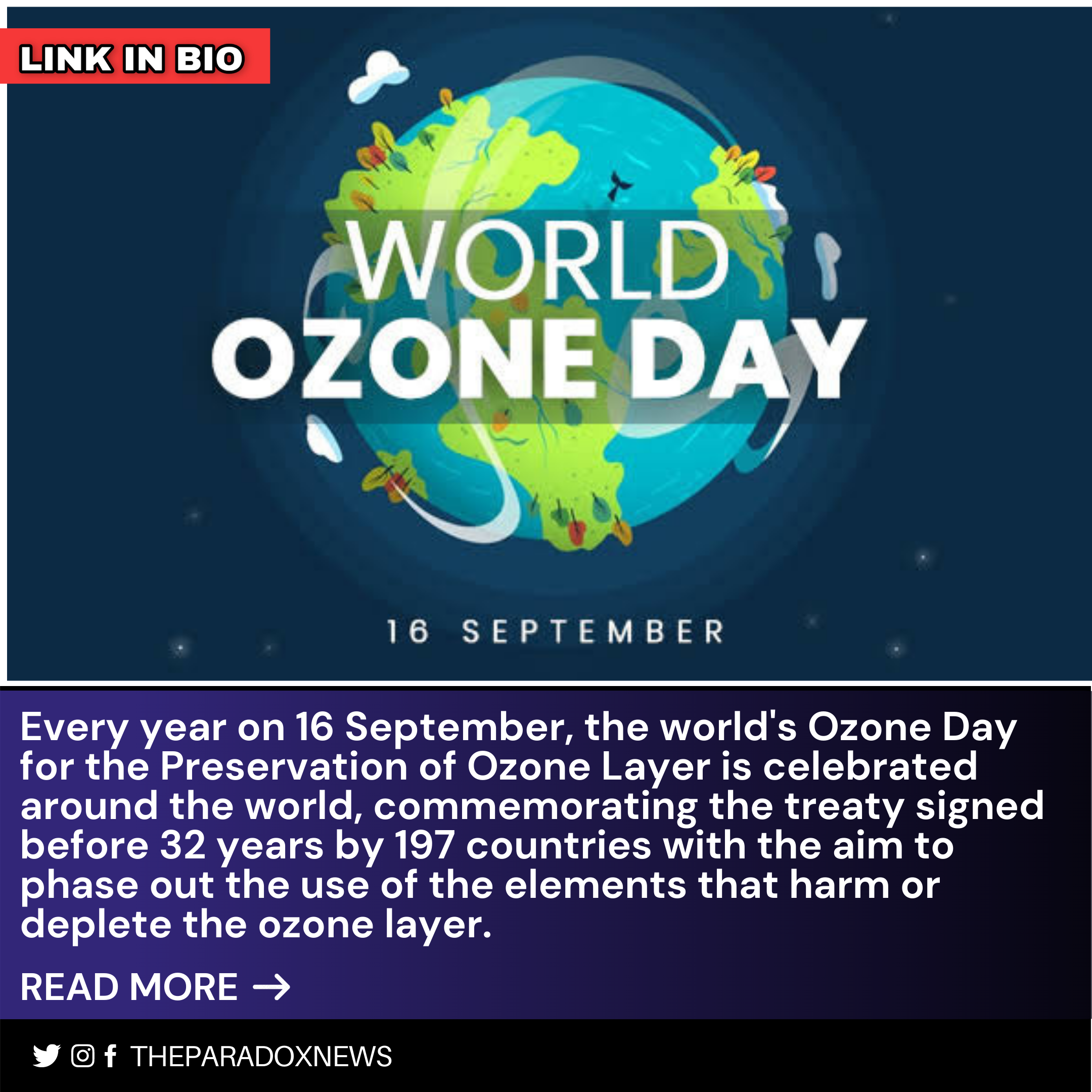
We can’t even think the existence of life without sunlight. But probably it would not have been possible to live the life we are living without the Ozone layer. This stratospheric layer that shields Earth from most of the sun’s harmful ultraviolet radiation facilitates life in this beautiful world with peace and harmony. And today, 16 September we celebrate the World Ozone Day, commemorating the treaty signed before 35 years by 197 countries to protect this precious gift of nature.
The Ozone layer which is also known as the Ozone shield is a delicate layer of gas in the Earth’s atmosphere that absorbs most of the Sun’s radiation which can be responsible for numerous skin problems and heart diseases.
Why we celebrate Ozone day:
Since, Industrialization era started a numbers of commonly used chemicals were beagn commencing for the different gadegts and appliances that proved to be extremely damaging to the ozone layer. Fluorine, Chlorine, Bromine or Iodine are some generally used chemicals that destroy the ozone layer when their atoms emerge with ozone in the stratosphere. Also, according to study, one chlorine atom is enough to destroy almost 1,00,000 ozone molecules before it vacates from the stratosphere. Ozone is very delicate and rapidly get destroyed while it takes years to be created naturally.
Later, with severe increase in the use of chemicals, scientists working in the late 1970s realized that human activities were slowly formulating a hole in this shield, gurading our environment and warnings were declared openly with an urging need to act open it. The hole – caused by ozone-depleting gases (ODSs) used in perfumes, cooling systems such as refrigerators and air-conditioners, was jeopardizing the life of humans and became responsible for the damage in ecosystems.
To preserve the ozone layer, in 1985, The Vienna Convention under the Montreal Protocal was signed for the protection of the Ozone layer. And it’s practical implications were enforced on 16 September, before 35 years. It is also recognized as the most successful international environmental agreement to date because it had phaseout more than 90% of chemicals harmful for environment. So, 16 September is celebrated as World Ozone Day, to highlight the achievement made by the collective efforts of everyone, Government, Industrialists, and local people.
Problems associated with Carbon Molecules:
Carbon outflux from Earth’s interior to the exosphere through volcanic eruptions, fault zones, and geothermal systems contribute to the global carbon cycle that effects short- and long-term climate of the Earth. Himalaya hosts about 600 geothermal springs having varied temperature and chemical conditions. Their role in regional and global climate, as well as the process of tectonic driven gas emission, needs to be considered while estimating emissions to the carbon cycle and thereby to global warming.
Wadia Institute of Himalayan Geology, an autonomous institute under the Department of Science & Technology, Govt. of India, which investigated and characterised the gas emissions from Himalayan geothermal springs, found that these springs which cover about 10,000 square km in the Garhwal region of Himalaya, show a significant discharge of Carbon dioxide (CO2) rich water. The estimated carbon dioxide degassing (removal of dissolved gases from liquids, especially water or aqueous solutions) flux is nearly 7.2 ×10⁶ mol/year to the atmosphere.
An approach towards being carbon neutral would mean excessive job loss and that’s the reason that amongst 196 countries only Bhutan has been the only country that has remained Carbon neutral. Bhutan is arguably the world’s happiest country. It’s also one of the greenest. That’s no coincidence. In fact, King Jigme Singye Wangchuck developed his signature Gross National Happiness index based on four pillars: sustainable development, environmental protection, cultural preservation, and good governance. Other countries have taken note, since the Himalayan kingdom is not only carbon neutral, but carbon negative.
As a travel destination Bhutan remains unique, sandwiched between its heavily industrialized neighbours China and India. The isolated nation only opened up to foreign visits in 1974 and allowed TVs in 1999.
Tshering Tobgay, Bhutan’s Prime Minister said at a Ted Talk in 2016 had said, “Bhutan has built sustainability into its national identity. “Our enlightened monarchs have worked tirelessly to develop our country, balancing economic growth carefully with social development, environmental sustainability, and cultural preservation, all within the framework of good governance”. In fact, the constitution of Bhutan mandates that 60 percent of its landmass be maintained and protected as forest. One of the ways the country maintains this is controlled through low impact tourism.
The Montreal Protocol
The Montreal Protocol on Substances that Deplete the Ozone Layer is the landmark multilateral environmental agreement that regulates the production and consumption of nearly 100 man-made chemicals referred to as ozone depleting substances (ODS). When released to the atmosphere, those chemicals damage the stratospheric ozone layer, Earth’s protective shield that protects humans and the environment from harmful levels of ultraviolet radiation from the sun. Adopted on 15 September 1987, the Protocol is to date the only UN treaty ever that has been ratified every country on Earth – all 197 UN Member States.
The Montreal Protocol phases down the consumption and production of the different ODS in a step-wise manner, with different timetables for developed and developing countries (referred to as “Article 5 countries”). Under this treaty, all parties have specific responsibilities related to the phase out of the different groups of ODS, control of ODS trade, annual reporting of data, national licensing systems to control ODS imports and exports, and other matters. Developing and developed countries have equal but differentiated responsibilities, but most importantly, both groups of countries have binding, time-targeted and measurable commitments.

-

 Entertainment6 years ago
Disha Patani is a National crush and Why?
-

 Paradox recommends6 years ago
WAJID KHAN song list forever in heart and on the playlist
-

 Interview6 years ago
Madhura Joshi Divekar tells us her story, passion and more.
-

 Entertainment5 years ago
Best bollywood villains of 90s and the iconic actors.
-

 Food6 years ago
Terrace Farming- A clever way to grow greens.
-

 Interview5 years ago
Tirth Parsana: one who gives a laughter pill
-

 Business6 years ago
Elon Musk : undaunted visionary character shaping our future
-

 Paradox recommends6 years ago
Top webseries you must watch.
-

 Fashion6 years ago
SABYASACHI LEHENGA : A dream of every girl.
-

 influencer stories5 years ago
Neha Kulkarni who does Nasti Uthathev!